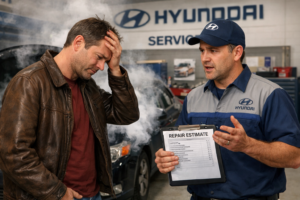
All they had to do is fix the car

All They Had to Do Was Fix the Car

By Charles Jackson

I actually like my Hyundai. I just wish I felt Hyundai liked me back.
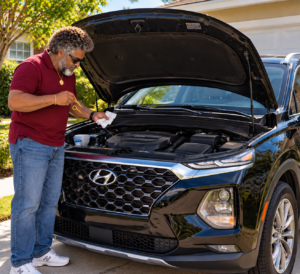
After repeated repair visits, recurring check engine lights, oil consumption and more follow-up calls than I care to count, I have reached a point I never expected: I am afraid to drive my own car.

I can smell what seems to be burning oil. I worry about what my children and I may be breathing. The car has stalled, leaving me scrambling to pull over and restart it. I no longer trust it for a trip outside the area. Now, I have parked it.

This is my family’s transportation. It is how I get to work, take my daughters to school and help keep our household moving. When the car fails, the consequences reach well beyond the repair shop.

I originally leased my 2020 Hyundai Santa Fe, then bought it when the lease ended. I also purchased extended warranty coverage because I wanted protection if something went wrong.

Something went wrong. What I have not received is a lasting repair.

The pattern has become painfully familiar: Take the car in. Receive an explanation. Authorize repairs. Get it back. Then, sometimes within days or weeks, watch the check engine light return.

My extended warranty has been billed for repairs, and I have faced charges myself. Yet the problems have continued. From where I sit, the process keeps producing repair bills without producing a car I can depend on.

The calls from Hyundai representatives have become another source of frustration. Someone calls while I am working, promises to follow up and schedules another conversation. Sometimes we connect; sometimes I miss the call. Either way, another week passes.

A follow-up call is welcome when it brings an answer. After enough calls without a resolution, it starts to feel like an appointment to keep waiting.

Meanwhile, I still have a job. I cannot spend every workday coordinating conversations about a car that is supposed to help me get to work in the first place.

Then there is the transportation problem while the vehicle is being serviced. I have repeatedly been told that no loaner car was available. Yet on one visit, I watched another customer leave in a dealership-branded loaner.

I do not know that customer’s circumstances or how the dealership assigned its vehicles. But after being told there was nothing available for me, watching someone else drive away raised a reasonable question: How are those decisions made?

Rental arrangements offered little relief. A preferred rental rate still meant paying for transportation while dealing with repairs, household expenses and time away from work.

During one breakdown around the Coachella festival period, I could not find an available rental car. I rented a U-Haul to get to work. Arriving in a moving truck created another problem at my workplace, but I was trying to solve the first one: showing up.

The costs have also been personal.

We have friends in Orange County we have not visited in about a year because I do not trust the car for the drive. My grandson welcomed a son in February, and I still have not traveled to the Inland Empire to meet my great-grandson. I want to see that child, but I do not want to strand my family on the way.

My twin daughters are 17. I had planned to give them the Hyundai as their first car. That plan is gone. I cannot hand my daughters the keys to a vehicle I am afraid to drive myself.

When one daughter wanted to visit a college campus in the Santa Barbara area, I rented a car. A trip to explore her future became another expense tied to our transportation troubles.

I also sought arbitration through the Better Business Bureau. The hearing schedule conflicted with work, and I did not attend. The arbitrator ruled in Hyundai’s favor. From my perspective, that process ended without resolving the problem that sent me there.

Now I am considering trading the car in. I dislike the thought of this vehicle becoming someone else’s headache, but I need dependable transportation. I cannot keep organizing my family’s life around the possibility of another breakdown.

To other owners facing recurring problems, my advice comes from experience: Keep your invoices, record each breakdown and seek qualified advice early. Do not let repeated promises of another inspection or another callback become your entire plan.

I bought extended coverage for peace of mind. Instead, I have spent my time arranging repairs, finding rentals, answering calls and wondering whether the next drive would end at the curb.

I did not want a fight with Hyundai. I wanted to keep a car I liked and use it to take care of my family.

All they had to do was fix the car.

After everything I have been through, I am still waiting for that to happen.

I originally titled this article as a cautionary tale. If they couldn’t fix it they were obligated to replace it. We all know about the lemon law rules. We also know that if you can stall long enough, you can bypass the lemon law rules all together, because you have successfully outlived the statute of limitations, and you have skirted your legal obligation to

conduct your business fairly.

The Lemon Experience

By Charles Jackson

My car is a 2020 Hyundai Santa Fe with the 2.4-liter GDI engine — the standard engine in the lower trims, the SE, SEL, and regular Limited. GDI stands for Gasoline Direct Injection: instead of mixing fuel with air before it enters the cylinder, the injectors spray fuel straight into the cylinder at very high pressure. It’s efficient on paper. In my driveway, it has been something else.

The engine also has Hyundai’s Idle Stop & Go system. Hold the brake at a light and the engine shuts off completely; lift your foot and it restarts. A few months back I started turning that system off by hand every trip — and my check engine light, a regular visitor before, hasn’t come on in about a month. I can’t prove the connection, but here’s a likely piece of it: this engine’s valve timing runs on oil pressure, and my car doesn’t hold onto its oil.
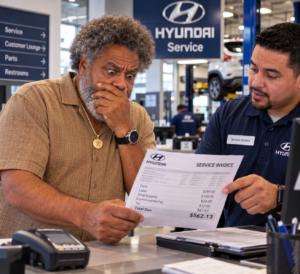
That’s the real problem. I have to add oil every 7 to 10 days, depending on how much I’m driving. At roughly 44 miles a day on my school runs, that’s a top-up every 300 to 450 miles. Hyundai’s own yardstick says burning more than about a quart per 1,000 miles is excessive. By that measure, my engine is burning oil at two to three times the rate Hyundai itself calls too much.

I’m not an isolated case, either. The 2020 Santa Fe is named in a Hyundai/Kia oil-consumption class action covering 2015–2021 Santa Fes, and the federal safety database is full of owners describing the same story: oil dropping below the low mark every few hundred miles, then stalling, low oil pressure, metal shavings in the pan, and engines failing outright from worn bearings. Oil starvation is what turns my problem into a dead engine, so I keep feeding it oil I shouldn’t have to buy.

Then there’s the other side of this — the waiting game. While my car sat in the shop, I was in rental cars, and it wasn’t accumulating miles because it wasn’t being driven at all. Meanwhile, the legal clocks kept ticking. California’s lemon law deadlines are measured in time, not in how the car was treated, and the recent AB 1755 changes shortened the window further: a claim now has to be filed within a year after the warranty expires, and no later than six years after the car was delivered. Every month spent “waiting on repairs” is a month off the owner’s clock. Whether it’s anybody’s plan or not, delay works in the manufacturer’s favor and against the person still making payments on a car that burns oil.

So here’s where I stand: still driving it, still topping it off, ISG off, and now keeping a written log — date, odometer, and how much oil went in, every time, receipts saved. “It burns a lot of oil” is an opinion. A quarts-per-mile figure is evidence. If you’re driving one of these engines and feeding it oil between changes, I’d suggest you start the same log. The clock is running either way.

No Matter Who Is At Fault, A Tent Is Not A Home.

No Matter Who Is At Fault, A Tent Is Not A Home.

Congresswoman Maxine Waters Condemns Trump Administration’s Attack on Homelessness Programs

By Charles Jackson

SHARE:

Congresswoman Maxine Waters has delivered a forceful rebuke of the Trump administration over its latest confrontation with Los Angeles and the agencies attempting to address one of the region’s most persistent humanitarian problems: homelessness.

Waters, who represents California’s 43rd Congressional District and serves as the ranking Democrat on the House Financial Services Committee, praised a federal court decision temporarily preventing the administration from suspending the Los Angeles Homeless Services Authority from federal homelessness grant programs.

At stake is approximately $241 million in federal funding, along with additional near-term funding supporting programs that provide services to more than 11,000 people.

For Waters, however, the dispute goes well beyond dollars.

Los Angeles County continues to face a staggering homelessness crisis, with nearly 73,000 people experiencing homelessness on any given night. They are individuals and families already living at society’s most vulnerable edge. Removing services designed to help them, Waters argues, does nothing to solve homelessness. It risks making an already desperate situation considerably worse.

Her criticism of the administration is unmistakable.

Rather than joining Los Angeles officials in confronting the shortage of affordable housing and the complicated causes of homelessness, Waters contends that the federal government has chosen confrontation. Suspending funding would threaten services without providing a meaningful alternative for the thousands of people depending upon them.

That is what makes the policy particularly troubling.

Government certainly has the right—and the responsibility—to demand accountability for taxpayer money. Homelessness programs should be expected to demonstrate results, operate efficiently and correct failures when they occur.

But accountability and abandonment are not the same thing.

Taking money away from programs serving people who have nowhere else to go does not magically produce housing. It does not lower rents, create shelter beds, expand mental-health treatment or provide permanent supportive housing.

It simply removes resources.

U.S. District Judge David O. Carter’s intervention temporarily stopped that from happening, a decision Waters welcomed as an important reprieve. Yet she cautioned against confusing a courtroom victory with a solution to homelessness itself.

The larger problem remains.

Americans need affordable housing, stable communities and a federal housing policy capable of recognizing homelessness as something more complicated than people sleeping on sidewalks.

Waters has advocated increased federal investment through her Ending Homelessness Act and has also pointed to bipartisan congressional efforts on housing as evidence that lawmakers with significant political differences can still work toward practical solutions.

Her message is ultimately a simple one: Government cannot claim to be fighting homelessness while simultaneously weakening the programs responsible for helping homeless people find their way back into housing.


The court may have protected these programs for the moment.

But the people sleeping in tents, automobiles, shelters and on sidewalks tonight cannot live on temporary court orders.

They need somewhere to live.

=====================

Ms. Waters’ full text

https://iqconnect.house.gov/iqextranet/view_newsletter.aspx?id=107826&c=CA43MW

Desertion

Desertion

     As of July 2026, 69 voting members of the U.S. Congress are not seeking re-election. This includes 11 members of ,Senate and 58 members of the House of Representatives. 

     That is a big number. Of the 69 total members leaving Congress:

  • ​There are 6 Senate: 6 Republicans (not counting Lindsey Graham, who passed away – placing his seat  in peril. Mitch McConnell will  not return) 
  • 5 Democrats are also leaving, (including independents caucusing with Democrats).
  • ​House of Representatives: 36 Republicans and 22 Democrats, are bailing out.

​In total, 42 Republicans and 27 Democrats are not seeking re-election.

Tariffs played a major role in the last fit of congressional carnage. During the Great Depression, lawmakers did not widely choose to retire or resign in the mid-term. Instead, a massive shift in Congress was driven by voters.

​In the 1930 and 1932 elections, voters overwhelmingly voted Republicans out of office due to the economic crisis, resulting in a historic loss of nearly 150 Republican seats in the House and Senate.

Unless you are a history buff, it’s likely that you are unaware of the identity shift that took place between the Democrats and the Republicans,  mid-century. If you’re one of those died in the wolves this or that, you may not even recognize yourself. Don’t get caught up in CRT, until you do a little reading. Know thyself.

Either the rabbits are scampering to holes, or the rats are deserting the ships.

Stay tuned.


The Party of One

The Party of One

­

What began as a supposedly nonpartisan national celebration appears to have taken a sharp detour into campaign-country.
The event’s original lineup looked like a strange but entertaining playlist assembled by someone spinning a giant wheel of nostalgia: Lee Greenwood, Christopher Macchio, Vanilla Ice, Flo Rida, Fab Morvan (still carrying the Milli Vanilli banner), military bands, drum corps, and armed forces choruses.

     Then came the withdrawals.

One by one, artists including The Commodores, Morris Day & The Time, Martina McBride, Bret Michaels, and Young MC reportedly decided they would rather spend the weekend doing literally anything else.    

   Several states—including Connecticut, Illinois, Maine, Massachusetts, North Carolina, Oregon, Pennsylvania, and Washington—also declined to participate, citing cost concerns and discomfort with the increasingly partisan tone of the event.


     At some point, attendees may have begun realizing they weren’t being invited to a national fair as much as they were being recruited as scenery.


     With the exits piling up, the remaining roster began to resemble a game of musical chairs where most of the chairs had already left the building. Those still standing could reasonably be described as either committed performers, true believers, or people whose agents stopped answering the phone.


     Notably absent from the discussion are several names observers expected to see. Some may be touring. Some may have wisely scheduled dentist appointments. Others may have simply decided that becoming a political talking point wasn’t worth the frequent-flyer miles.


     In the end, President Donald Trump reportedly canceled the remaining concert schedule altogether and replaced it with what the event seems to have been evolving into from the start: a massive political rally headlined by himself.

Which raises the obvious question: If a nonpartisan celebration slowly sheds its musicians, loses participating states, transforms into a campaign-style rally, and ends with a speech by the politician at the center of it all—was it ever really nonpartisan in the first place?


     Sometimes the most revealing part of a concert is not who’s on stage.

It’s who left before the show started.


“At some point, attendees may have begun realizing they weren’t being invited to a national fair as much as they were being recruited as scenery.”

But Not Today

      During his first term, Trump successfully lobbied FIFA and secured the winning joint “United Bid” for the U.S., Canada, and Mexico to host the 2026 World Cup.The FIFA World Cup 2026 is officially underway in the United States, Canada, and Mexico. Major city centers across the U.S. are hosting, and “watch parties” are circling the venues and perhaps portions of the world.

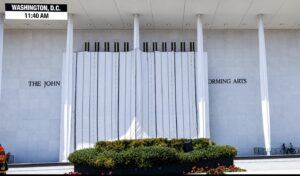
The image below is a different, yet important localized, but growing trend focusing on a “watch party” in Washington DC. This watch party stands at the scene of the Kennedy Center treasure. The tarp conceals the removal of Trump’s name from this national tresure, as dictated by the court.

More importantly, this removal of the illegal stain of what some people considered to be graffiti, marks the first step in the removal of the legacy that he has spent the last 18 months attempting to build.

But not today…

Dig and burn, baby. Dig and Burn

Dig and burn, baby. Dig and Burn

I won’t go as far as to say he’s lying when he claims that China is successful because they burn a lot more coal than we do in the states.

By comparison,  China’s power consumption ratio is 51% while the US ratio is a mere 17%. So the big guy’s got me there… Sorta.


     The US has proudly converted to renewable energy as a means of burning quieter wicks of coal – and the big guy doesn’t like progressive shenanigans when good old fashioned ancients will do. I won’t twist your arms today and get into a debate about pneumoconiosis. That’s another story about another day. Google it yourself.

     I will argue that China’s use of coal has dropped from 70% down to 51% coal to renewable ratio, their population is 4x the size of ours in the US.

     So as to avoid hurt feelings, I will spieak softly about looking at the world, through rose-colored glasses while China’s reliance on coal power is well in decline, as was ours until our guy decided again to dig and burn baby, dig and burn our way back into the cave man days. (did I mention pneumoconiosis?)

     I get it. Competition. Without competition, we would be obliged to work together. We want to fire up the space race again and be the first ones to dig a hole on the moon, while at the same time we want to be the first ones to dig a deeper hole on planet Earth.


Sada Tay.

Story: Charles Jackson

Let the Robots Into the Studio.

The Day the Music Industry Let the Robots Into the Studio.

For decades, the record business treated artificial intelligence the way Dracula treated daylight: avoid at all costs, issue dramatic legal threats, and send expensive lawyers carrying sharpened cease-and-desist letters. Now? The vampires appear to be installing Wi-Fi in the castle.

In what may become one of the strangest turning points in modern music history, newsroom.spotify.com⁠ and universalmusic.com⁠ announced a new licensing partnership that will allow fans and creators to generate AI-powered cover songs and remixes using participating artists’ catalogs.
Spotify.
The same music industry that once acted like a teenager downloading LimeWire in 2002 was equivalent to nuclear espionage is now apparently saying: “Alright… maybe the robots can sing a little.”
According to Spotify’s official announcement, its new feature will launch as a paid add-on for Premium subscribers and will focus on AI-generated licensed covers and remixes. Spotify says the system is built around three magic corporate buzzwords: “consent, credit, and compensation.”
Translation:
“We finally found a way to monetize the apocalypse.”
The move represents a dramatic cultural shift for major labels, especially Universal Music Group, which only recently spent considerable energy battling unauthorized AI music platforms and defending artist copyrights. In fact, UMG previously reached agreements with AI music companies like Udio after legal warfare over copyrighted training material.
UMG
Now the same industry that once screamed, “AI is stealing music!” is quietly adjusting the studio microphone for it. And honestly, maybe they had no choice.

The internet already resembles a cyberpunk karaoke bar at 3 a.m. Somewhere right now, a teenager in Nebraska is probably generating an AI version of Frank Sinatra singing a Kendrick Lamar diss track while an AI Elvis harmonizes in the background. The toothpaste is not merely out of the tube — the toothpaste has released three mixtapes and launched a Patreon.
Spotify appears to understand this reality better than most. The company is aggressively leaning into AI products as part of its future business strategy. Beyond music remixes, Spotify also unveiled AI-generated podcast tools and other “superfan” features intended to drive new revenue growth through 2030.
Reuters
Wall Street loved it. Spotify stock reportedly jumped sharply after the announcement.
     Of course it did.
Investors hear phrases like “new monetization ecosystem” and immediately begin levitating several inches above the floor.
Still, the announcement raises massive questions about the future of artists, creativity, and authenticity.
     Will listeners care whether a song is sung by a human being anymore?

Or are we entering an era where audiences simply shrug and say:
“If it slaps, it slaps.”
That possibility terrifies traditional musicians. For years, artists fought to preserve the mystique of originality — the idea that music carried fragments of human struggle, heartbreak, and experience. But AI systems can now mimic vocal styles, recreate production aesthetics, and manufacture emotionally convincing songs in seconds.
The result could become musical chaos.
Imagine:
*   AI Tupac featuring AI Prince.
*   A synthetic Johnny Cash singing trap music.
*   An AI-generated Motown ballad accidentally becoming a global hit.
Five million fake Drake songs appeareing online before breakfast.
Some of that sounds hilarious. Some sounds horrifying. Most sounds inevitable. And the record labels know it.
That is why this Spotify-UMG agreement matters. It signals that major labels may be abandoning the old strategy of trying to stop AI altogether. Instead, they appear ready to build toll booths around it.
If people are going to make robot music anyway, the industry wants a percentage.
To be fair, Spotify and UMG insist participating artists will opt in voluntarily and receive royalties from AI-generated creations.
That could create a bizarre but lucrative future where artists license “digital vocal likenesses” the same way celebrities license action figures or video gam

e appearances.
In other words: Your favorite singer may someday retire from touring entirely while their AI clone keeps dropping albums every six months forever. Immortality, but with subscription billing.
Meanwhile, researchers are already racing to create systems that can detect.
AI-generated music because distinguishing humans from algorithms is becoming increasingly difficult.
That may soon become necessary because the next generation of listeners could grow up in a world where the line between “artist” and “software operator” barely exists. And perhaps that is the real story here.
The music industry once feared AI would burn down the building.
Now it is inviting the robots inside, handing them backstage passes, and asking whether they would like merchandising rights.
If you’re old enough, you may have been forced to accept the synthesizer that sounded just like your original $895 74-key Fender Rhodes. You learned to appreciate the first drum machine that landed in the studio. The magic of Pro-Tools was hard to swallow, but before long, using that tool to sample and share your name on a split sheet with James Brown, the most sampled musician of all times didn’t hurt hardly at all.
Ultimately It may well be wiser and more profitable to happily split the check, than grumble and complain yourself into the poor house.
It’s better to play ball, than to be the ball.


Story: Charles Jackson

Hyundai: Warranty Promise vs. Customer Reality

The 2020 Hyundai Santa Fe: Warranty Promise vs. Customer Reality

The 2020 Hyundai Santa Fe was marketed with one of the most aggressive value propositions in the auto industry: a 10-year/100,000-mile powertrain warranty, positioned as a safeguard against exactly the kind of catastrophic engine issues that concern long-term owners. On paper, it is a compelling offer. In practice, a growing number of cases suggest that the pathway to actually using that warranty can be far more complicated.

A Pattern of Deflection at the Dealership Level

Across multiple service encounters, a consistent pattern emerges: initial symptoms are minimized, redirected, or reclassified in ways that move responsibility away from Hyundai.

Customers report bringing vehicles in with check engine lights, oil consumption, or drivability issues—only to receive:

Temporary fixes, such as clearing diagnostic codes

Secondary explanations (like EVAP system issues) that do not address underlying engine performance

Diagnoses that attribute problems to “external damage,” which can immediately disqualify warranty coverage

In many instances, the first diagnosis becomes the most important—not because it is correct, but because it shapes how warranty claims are evaluated downstream.

The “Damage” Narrative and Warranty Denials

One of the more consequential trends involves labeling issues as impact-related or customer-caused damage. Once this classification is entered into the service record:

Third-party warranty providers often deny claims outright

Hyundai’s own warranty coverage may be sidestepped

The financial burden shifts to the customer

Independent inspections in some cases have contradicted dealership claims of damage, raising concerns about whether these determinations are always technically sound—or strategically convenient.

Engine Concerns: The Issue Beneath the Surface

Beyond isolated components, the more serious concern centers on engine reliability in certain Hyundai and Kia models from this era.

Reported symptoms include:

Excessive oil consumption

Engine knocking or ticking

Stalling at idle or in traffic

Sudden loss of power or complete shutdown

These issues have been widely discussed in both mechanic circles and owner communities, often tied to internal engine wear involving bearings and other core components. Hyundai has acknowledged some of these risks through recalls and extended warranties, but accessing those remedies typically requires specific diagnostic confirmation—which not all dealerships appear eager to establish early.

Delayed Recognition, Escalated Damage

A critical failure point in many cases is timing. When early warning signs appear:

Vehicles are often returned to service without deep mechanical inspection

Drivers continue operating cars with unresolved internal issues

Minor symptoms evolve into major engine failure

By the time the problem becomes undeniable—stalling in traffic, failure to restart, or severe knocking—the damage may be extensive. At that stage, customers often face a new hurdle: proving that the failure qualifies under warranty terms.

Structural Tension: Warranty vs. Business Incentives

There is also a structural dynamic at play. Dealerships operate within a system where:

Warranty repairs are reimbursed at controlled rates

Customer-paid repairs are more profitable

This creates a subtle but important incentive: classifying a repair as non-warranty can be financially advantageous. While not universal, this tension appears frequently enough in customer accounts to raise legitimate concern about consistency and objectivity in diagnostics.

Recall Awareness Without Resolution

Hyundai has issued recalls and software updates tied to engine monitoring systems, such as knock detection. However, owners often report that:

Recall visits focus narrowly on the required update

Broader engine complaints are not addressed unless failure thresholds are met

Preventative intervention is limited

This approach can leave customers in a reactive cycle—waiting for failure rather than preventing it.

The Customer Experience: Friction and Financial Exposure

For many Santa Fe owners, the result is a frustrating loop:

Repeated service visits with inconsistent conclusions

Out-of-pocket expenses for disputed repairs

Difficulty getting independent mechanics involved

Escalation attempts through consumer channels with limited resolution

Even with warranty coverage theoretically in place, customers may find themselves paying thousands of dollars while driving vehicles that remain mechanically unstable.

Conclusion: A Warranty That Requires Navigation

The 2020 Hyundai Santa Fe is not defined solely by its engineering or its features, but increasingly by the experience owners have when something goes wrong.

The central issue is not whether Hyundai offers strong warranty coverage—it does. The issue is how that coverage is applied, interpreted, and accessed in real-world situations.

For many customers, the challenge is not just mechanical failure. It is navigating a system where:

Diagnoses can shift

Responsibility can be reassigned

And the burden of proof often falls on the owner

In that environment, the promise of long-term protection becomes less about coverage—and more about persistence.


As a member of the Hyundai owner losers club, I can only offer a cautionary tale. I foolishly ignored the fact that my service technician never looked me in the eye when he was lying to my face. Because I have been a consistent cash cow, replacing tires and brakes on their say so. He misdirected my vehicle’s problem to a damaged canister. (whatever that is) But when a retired relative sent me to another certified mechanic, I discovered that the canister was not defective and not the cause of my problem. I have the part stashed away.

     But where does one go from here?  The internet has hinted at a class action lawsuit already underway, but I was hoping to just have my car repaired.  The BBB has already failed to resolve the matter through arbitration, and a Lemon Law Lawyer is standing by waiting for discussions with the Office of the Attorney General, who might be looking to make a stink as we approach the election.

My car sat in the repair shop as I was forced to retreat into a rental car for a week. The initial problem was a bad starter. I suggested that the starter failed because the engine kept stalling, which forced repeated restarts. Fortunately, the extended warranty covered that resolution.  There still remained the check engine light that had plagued the vehicle for over a year. The same codes were displayed, and the technician initially called it a failure due to a non OEM, aftermarket MAP SENSOR, but when an OEM part was installed, the system still failed. after a week of testing, and a $600 repair, the check engine light and several other lights appeared. The engine sputtered, failed and then would not start for an hour.

Now I am back in a rental car, and likely will require another flatbed tow.

The Modern Town Hall

Access, Engagement, and the Modern Town Hall: A Reflection on Congresswoman Maxine Waters’ Forum. This is how we roll.

On April 2, 2026.


Congresswoman Maxine Waters hosted a telephone town hall for residents of California’s 43rd Congressional District. The event followed a familiar and increasingly important format in modern civic life: structured, accessible, and designed to reach a broad audience across a large and diverse community.

For many constituents, especially those who may not attend in-person events, this format offers something valuable—a practical entry point into civic participation. And that is worth recognizing at the outset.

A Gateway to Participation

Telephone town halls are not meant to replicate the intensity or spontaneity of live, in-person gatherings. Instead, they serve a different purpose: scale and accessibility.

In a district as expansive and complex as the 43rd—encompassing Inglewood, South Los Angeles, and surrounding areas—bringing thousands of voices into even a shared listening space is no small achievement. The ability to dial in, hear directly from a sitting member of Congress, and potentially ask a question lowers the barrier to engagement.

For many residents, especially seniors or those balancing work and family responsibilities, this may be the most realistic way to connect with their representative.

Structure as Stability

The April 2 event was carefully moderated, with a facilitator guiding the flow of the conversation. Callers were introduced, questions were time-limited, and transitions were smooth. While this structure can feel formal, it also ensures that the event remains focused and respectful of participants’ time.

Roughly 15 to 20 constituents were able to speak—sharing concerns about housing affordability, economic opportunity, healthcare access, and public safety. These are not new issues in the district, but they remain urgent, and the town hall provided a platform for them to be voiced directly.

Importantly, the tone of the event appeared measured and constructive. Participants were able to express concerns without the disruptions that sometimes characterize large public meetings. In that sense, the format created a safe and orderly environment for dialogue, even if it was necessarily brief.

Waters’ Approach: Detailed and Direct

Congresswoman Waters brought her characteristic command of policy to the discussion. Her responses reflected decades of legislative experience, particularly in areas tied to economic justice, financial systems, and community development.

She addressed questions with specificity—referencing federal programs, ongoing initiatives, and the broader legislative landscape. For constituents seeking clarity on what is being done at the federal level, this level of detail matters.

At the same time, she encouraged continued civic engagement. Her messaging emphasized that participation does not end with a phone call—it extends into voting, organizing, and staying informed. References to broader civic themes, including calls for vigilance and public involvement, underscored her long-standing belief in active citizenship.

The Sanctuary City Context

The 43rd District operates within the broader framework of Los Angeles County, a region often described as aligned with sanctuary policies. This context shapes many of the conversations around public safety, immigration, and community trust.

In a telephone town hall setting, these issues tend to be approached in a measured way. The format naturally encourages concise questions and equally concise responses, which can make it difficult to fully explore complex or sensitive topics.

However, the value of the forum lies in introducing these issues to a wide audience. Even brief exchanges can raise awareness, clarify positions, and encourage further discussion beyond the call itself.

Rather than serving as the final word on such matters, the town hall functions as a starting point—a place where concerns are surfaced and where constituents can begin to engage more deeply in the issues that affect their communities.

Complementing, Not Replacing, In-Person Dialogue

It is important to view telephone town halls as one piece of a larger civic ecosystem. They are not designed to replace in-person meetings, where longer exchanges, follow-up questions, and more dynamic interaction can take place.

It should be noted that I, as the writer of this article, have attended several of Congresswoman Waters’ live town halls, and that perspective is important. Those settings often allow for a different kind of energy—sometimes more assertive, sometimes more interactive, but always more immediate.

The telephone format, by contrast, offers reach over depth. And in a district of this size, both are necessary.

A Broader Tradition of Engagement

There is also value in remembering that civic participation takes many forms. The legacy of Martin Luther King Jr. reminds us that engagement can be quiet as well as vocal—structured as well as spontaneous.

Nonviolent protest, silent marches, and sit-ins were not just acts of resistance; they were also acts of presence. They created space for voices to be seen and felt, even without extended dialogue.

In a different way, telephone town halls also create space—less visible, perhaps, but still meaningful. They allow people to listen, reflect, and begin to form their own responses.

Finding the Balance

The April 2 town hall illustrates a balance that many public officials are still working to refine:

Accessibility vs. depth

Structure vs. spontaneity

Efficiency vs. extended dialogue

No single format can fully satisfy all of these needs. But when used thoughtfully, each can contribute to a more engaged and informed public.

In this case, the event appears to have succeeded in its core objective: connecting a large number of constituents with their representative in a way that was organized, informative, and approachable.

Conclusion: A Useful Starting Point

Telephone town halls may not capture the full energy of in-person civic life, but they serve an important role. They open the door to participation, especially for those who might otherwise remain on the sidelines.

Congresswoman Maxine Waters’ April 2 forum fits squarely within that purpose. It provided information, invited questions, and encouraged continued engagement—without requiring constituents to leave their homes.

And perhaps that is the most practical way to view it:

Not as the final destination for civic dialogue, but as a welcoming front porch—a place where people can gather, listen, and take the first step toward deeper involvement.

From there, the conversation can—and should—continue.


As a teenager, growing up in, southwestern Ohio, during the late 1960s, civic engagement often turned necessarily or perhaps unnecessarily ugly. We were there, because we were there. Now, we are here, because we are here, again.

Story: Charles Jackson