
Inglewood Mayor James Butts recently responded to a series of allegations lodged against him by Councilwoman Gloria Gray, recently reported in the Inglewood Today

shedding light on a contentious debate within Inglewood’s city government. Gray’s accusations, which include claims of abuse of power, alleged ethical breaches, and potential conflicts of interest, have raised questions about leadership accountability and transparency in one of Southern California’s fastest-evolving cities.

Mayor Butts, however, has firmly denied these accusations, characterizing them as politically motivated and an attempt to undermine his administration’s recent successes.
Gray’s accusations against Butts span a range of issues, including alleged misuse of city funds, preferential treatment for certain developers, and potential retaliation against city employees who do not align with his directives. This has escalated concerns about how Inglewood’s rapid development and transformation—particularly around high-profile projects such as SoFi Stadium and the Clippers’ new Intuit Dome—are affecting governance and oversight. Gray argues that Butts has contributed to an environment where the interests of developers and private investors are prioritized over those of the local community. These allegations underscore broader concerns that have surfaced amid Inglewood’s significant economic and demographic changes, with rising costs and displacement adding tension to an already complex political landscape.
In response, Butts has categorically denied all claims, positioning himself as a pragmatic leader committed to transforming Inglewood into a thriving urban center. He argues that his decisions have prioritized economic growth, job creation, and community revitalization, which he believes will ultimately benefit Inglewood residents. According to Butts, the accusations from Gray lack substantive evidence and are part of an effort to discredit his administration ahead of upcoming elections. He maintains that his administration has been transparent about its objectives and has made a concerted effort to keep residents informed on city planning decisions.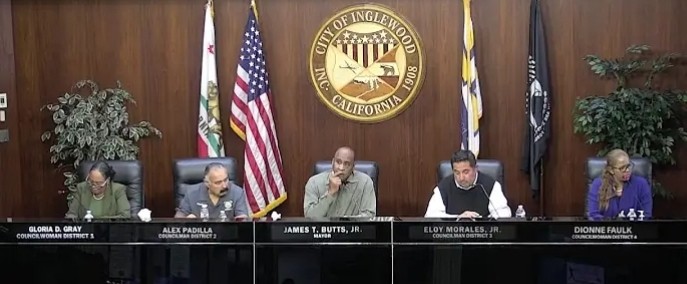
Butts also highlighted the substantial economic benefits brought by recent developments, which have revitalized the city’s image and attracted considerable business interest. He points to the economic impact of hosting the NFL’s Los Angeles Rams and Chargers at SoFi Stadium, as well as the anticipated benefits of the new Clippers arena. According to Butts, these projects have created thousands of jobs and will continue to drive long-term economic growth, offering opportunities for local residents and businesses alike. He has dismissed claims that his administration shows favoritism to developers, asserting that all projects are pursued with the broader public good in mind.
However, Gray’s allegations have struck a chord with some residents who feel that Inglewood’s rapid gentrification is leaving long-time community members behind. Rising rents and property values have priced some residents out of their neighborhoods, and critics argue that Butts’ approach to development has exacerbated these challenges. Some community advocates support Gray’s call for increased transparency and accountability, insisting that development should not come at the cost of displacing Inglewood’s most vulnerable populations. They argue that decisions around land use and city planning should prioritize affordable housing and measures to protect low-income residents.
In his rebuttal, Butts pointed to several initiatives aimed at addressing these concerns, including affordable housing projects and measures to prevent displacement. He argues that his administration has worked to balance economic development with community needs, though he acknowledges that Inglewood’s transformation has created difficult trade-offs. Butts insists that he remains committed to affordable housing and has enacted policies aimed at preserving the community’s socioeconomic diversity. He attributes Inglewood’s rising property values and increased interest from investors to the city’s transformation from a struggling suburb to a regional destination with robust infrastructure and amenities.
The back-and-forth between Butts and Gray has underscored the complex dynamics at play in Inglewood, where rapid growth and demographic shifts have sparked debates over economic justice and equitable urban development. Gray’s accusations and Butts’ response reflect a broader conversation occurring in many urban areas experiencing similar challenges. As development continues to shape the city, questions about who benefits and who bears the costs have become more pronounced.
Gray has called for an independent investigation into Butts’ alleged actions, which she believes would clarify his administration’s role in several recent development deals. Her push for transparency has garnered support from some community organizations and residents, who view an independent review as a necessary step to address perceived ethical lapses within Inglewood’s government. Gray argues that only through an unbiased investigation can the city fully address concerns about conflicts of interest and ensure that decisions are being made in the public’s best interest.
Butts, however, views the call for an independent investigation as a political tactic rather than a necessary measure. He contends that his administration has operated within legal and ethical boundaries and that the ongoing development projects align with Inglewood’s strategic vision for a prosperous future. According to Butts, efforts to hinder these projects could ultimately harm the community by limiting access to economic opportunities. He believes that his administration has successfully steered Inglewood through significant challenges and that his record speaks to a dedication to responsible and progressive city governance.
The dispute between Mayor Butts and Councilwoman Gray has illuminated the broader societal shifts impacting Inglewood and other similarly situated communities. As the city continues to evolve, the balance between fostering economic development and maintaining community stability remains delicate. Butts argues that his administration’s policies will ultimately benefit all residents, while Gray insists that unchecked development risks leaving long-time residents behind. In this environment, the demand for transparent governance and accountability has only grown, as residents and city officials navigate the complexities of urban change.
The outcome of this dispute may have implications not only for Inglewood’s future but also for the political careers of Butts and Gray. As the city grapples with competing visions for its development, residents are likely to weigh the promises of economic growth against concerns over rising costs and the preservation of community identity. The ongoing conversation between Mayor Butts and Councilwoman Gray has brought these issues to the forefront, inviting further scrutiny on how Inglewood’s leaders can achieve a just and inclusive transformation.
While questions related to city elections have been raised, the mayor and Councilwoman Gray were not implicated in this election cycle. However, a so far small group of citizens are informally asking the mayor to step down.
