
 During a recent meeting of the Carson City Council in the City of Carson, California, a heated discussion emerged around the city’s paratransit service program — specifically the contract for its “Dial-A-Ride” service for seniors and disabled residents. The focal point: the proposed shift in contract from the longtime local provider Yellow Cab of Los Angeles (and its affiliate) to the ride-hailing giant Uber. From the remarks of Councilman Jawane Hilton of
 District 1, who anchored much of the discussion, the decision appears to have been shaped by resident testimony, service-quality concerns, and the unique transportation needs of seniors and disabled individuals.
Councilman Hilton opened by noting that Carson residents spoke “clearly and passionately” about the dependable service they have received from Yellow Cab over decades — especially for seniors and disabled riders. According to his account, Yellow Cab has built relationships, trust, and service protocols familiar to clients who rely on curb-to-curb rides for medical appointments, trips to visit loved ones, and maintaining a quality of life. From his viewpoint, the motion to award the Dial-A-Ride contract to Uber — even though  Uber currently lacks handicap-accessible vehicles and has a record of service complaints — risked undermining those relationships.
Hilton proposed a compromise: rather than sole-sourcing the service to Uber, split the contract so that Yellow Cab would continue providing transportation specifically for the seniors and disabled passengers, while also launching an outreach and education initiative to boost awareness of the service, aiming to improve access for residents who may not yet be familiar with how to use the program. His substitute motion prevailed after debate, ensuring that the senior and disabled segment would remain protected rather than shifted entirely to a new vendor.
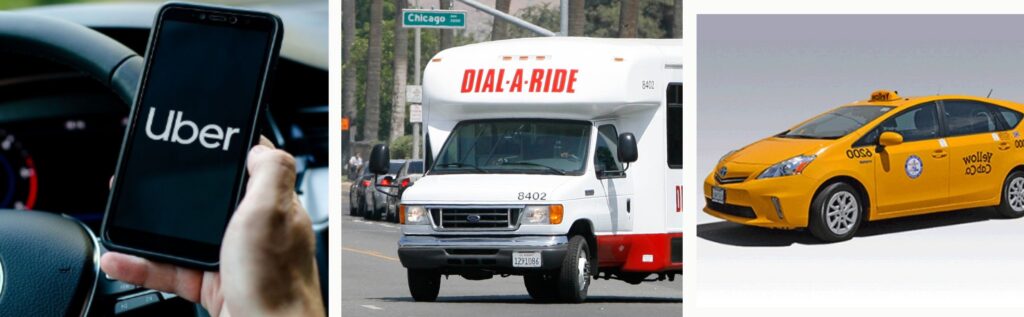
The significance of the issue extends beyond the simple vendor choice. At stake is access, continuity of care, and service equity. Riders with disabilities or mobility constraints often rely not only on a ride being available, but on the driver’s familiarity with their needs, the timing and reliability of the ride, and the ability to book via phone rather than purely through smartphone apps. During the council meeting, residents and disability advocates emphasized that the ability to call in, the familiarity of the driver, and the consistency of service matter as much as cost or app-based convenience.
From publicly available meeting summaries, staff had recommended awarding the contract to Uber as the single contractor after a standard RFP. But following vigorous public comment and council debate, the Council directed city staff to develop a dual-provider approach, allocating trips between two vendors and returning to the Council with revised contract drafts. The city emphasized that any interim contract must include termination and performance remedies, ensure phone-based booking for residents unable to use apps, preserve the role of local taxi drivers, and prevent service disruptions during the transition.
From the resident perspective represented by Councilman Hilton, the key concerns were: (1) whether shifting to Uber alone would disrupt the continuity of service for seniors and disabled riders; (2) whether Uber’s fleet is equipped (or lacking) in terms of accessible vehicles for those who use wheelchairs or other mobility aids; (3) whether an app-based dispatch-only model sufficiently addresses the population in Carson who depend on low-cost, accessible transportation and might struggle with smartphone-only scheduling.
By securing a split contract and preserving Yellow Cab’s longstanding role, the council effectively hedged against the risk of service gaps or degradation. Councilman Hilton’s argument was that while innovation and new service models can offer efficiencies, the city cannot compromise the quality of service for vulnerable populations in the name of cost or modernization alone.
At the same time, the decision reflects a balancing act in municipal procurement: on the one hand, the possibility of integrating ride-hail platforms like Uber which may promise more flexibility or lower cost; on the other hand, the imperative to maintain local vendor capacity, ensure equity of access (especially for non-smartphone users), and preserve service relationships tailored to vulnerable users. The outreach and education component proposed by Hilton also signals a recognition that simply changing providers is not enough — residents need to know how to navigate the service.
One of the broader themes here is the intersection of public procurement, senior and disability services, and the evolving ride-share economy. As traditional taxi services face competition from app-based alternatives, municipalities like Carson are tasked with ensuring that vulnerable riders are not left behind in the transition. Issues of accessibility, trust, reliability, and digital literacy become just as important as pricing and vendor innovation.
Councilman Hilton’s emotional tone (“Yes I was passionate but at times that is what is required,” as he put it) underscored the stakes from his perspective: that seniors and disabled residents of Carson must not see a drop in service simply because of a shuffle in vendors. It was not about rejecting Uber outright, but about preserving local service infrastructure and ensuring that the replacement or addition of vendors does not erode service quality.
In sum: The City of Carson Council’s decision — guided by Councilman Hilton’s advocacy — reflects a cautious approach to modernizing paratransit services. By approving a substitute motion to split the contract rather than awarding it solely to Uber, the council upheld continuity for seniors and disabled riders via Yellow Cab while opening the door to new service models and outreach efforts. The resolution therefore attempts to balance innovation with equity, responsiveness with reliability, and cost-efficiency with human needs. The key test ahead will be the implementation: whether the dual-provider model maintains the service levels residents expect, whether the access and education programs reach the intended audience, and whether the transition avoids disruptions for those most dependent on the service.
As the writer of this story, I try to avoid editorialising and conflating personal perspectives into a piece, however I put myself through college, driving a yellow cab, and spent considerable time behind the wheel of a Super Shuttle, or Uber and recently retired as a Metro driver. I was often in the seat, servicing Carson residents on the 246 line down Avalon.
As a rule, passengers with disabilities will most always find comfortable accommodations on Metro buses, but the few times that I needed to accommodate a wheel chair when driving an Uber – it was not a great experience, because my vehicle was a compact SUV, when they should have ordered a Comfort, or even an Uber Black. The range and size of vehicle requests, sight unseen can sometimes vary, and cancellation is not always pleasant. When Councilman Hilton reached out to me, I was intrigued by the opportunity to help spread the word about such a dynamic issue, that while smoothed over in compromise, it may yet face continuous debate.
Stay Tuned.
