
The 2020 Hyundai Santa Fe: Warranty Promise vs. Customer Reality
 The 2020 Hyundai Santa Fe was marketed with one of the most aggressive value propositions in the auto industry: a 10-year/100,000-mile powertrain warranty, positioned as a safeguard against exactly the kind of catastrophic engine issues that concern long-term owners. On paper, it is a compelling offer. In practice, a growing number of cases suggest that the pathway to actually using that warranty can be far more complicated.
A Pattern of Deflection at the Dealership Level
Across multiple service encounters, a consistent pattern emerges: initial symptoms are minimized, redirected, or reclassified in ways that move responsibility away from Hyundai.
Customers report bringing vehicles in with check engine lights, oil consumption, or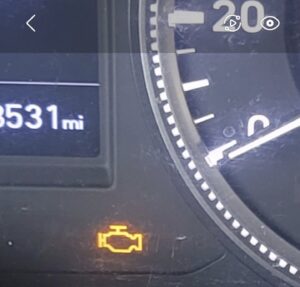 drivability issues—only to receive:
Temporary fixes, such as clearing diagnostic codes
Secondary explanations (like EVAP system issues) that do not address underlying engine performance
Diagnoses that attribute problems to “external damage,” which can immediately disqualify warranty coverage
In many instances, the first diagnosis becomes the most important—not because it is correct, but because it shapes how warranty claims are evaluated downstream.
The “Damage” Narrative and Warranty Denials
One of the more consequential trends involves labeling issues as impact-related or customer-caused damage. Once this classification is entered into the service record:
Third-party warranty providers often deny claims outright
Hyundai’s own warranty coverage may be sidestepped
The financial burden shifts to the customer
Independent inspections in some cases have contradicted dealership claims of damage, raising concerns about whether these determinations are always technically sound—or strategically convenient.
Engine Concerns: The Issue Beneath the Surface
Beyond isolated components, the more serious concern centers on engine reliability in certain Hyundai and Kia models from this era.
Reported symptoms include: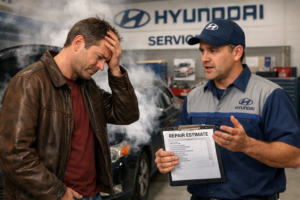
Excessive oil consumption
Engine knocking or ticking
Stalling at idle or in traffic
Sudden loss of power or complete shutdown
These issues have been widely discussed in both mechanic circles and owner communities, often tied to internal engine wear involving bearings and other core components. Hyundai has acknowledged some of these risks through recalls and extended warranties, but accessing those remedies typically requires specific diagnostic confirmation—which not all dealerships appear eager to establish early.
Delayed Recognition, Escalated Damage
A critical failure point in many cases is timing. When early warning signs appear:
Vehicles are often returned to service without deep mechanical inspection
Drivers continue operating cars with unresolved internal issues
Minor symptoms evolve into major engine failure
By the time the problem becomes undeniable—stalling in traffic, failure to restart, or severe knocking—the damage may be extensive. At that stage, customers often face a new hurdle: proving that the failure qualifies under warranty terms.
Structural Tension: Warranty vs. Business Incentives
There is also a structural dynamic at play. Dealerships operate within a system where:
Warranty repairs are reimbursed at controlled rates
Customer-paid repairs are more profitable
This creates a subtle but important incentive: classifying a repair as non-warranty can be financially advantageous. While not universal, this tension appears frequently enough in customer accounts to raise legitimate concern about consistency and objectivity in diagnostics.
Recall Awareness Without Resolution
Hyundai has issued recalls and software updates tied to engine monitoring systems, such as knock detection. However, owners often report that:
Recall visits focus narrowly on the required update
Broader engine complaints are not addressed unless failure thresholds are met
Preventative intervention is limited
This approach can leave customers in a reactive cycle—waiting for failure rather than preventing it.
The Customer Experience: Friction and Financial Exposure
For many Santa Fe owners, the result is a frustrating loop:
Repeated service visits with inconsistent conclusions
Out-of-pocket expenses for disputed repairs
Difficulty getting independent mechanics involved
Escalation attempts through consumer channels with limited resolution
Even with warranty coverage theoretically in place, customers may find themselves paying thousands of dollars while driving vehicles that remain mechanically unstable.
Conclusion: A Warranty That Requires Navigation
The 2020 Hyundai Santa Fe is not defined solely by its engineering or its features, but increasingly by the experience owners have when something goes wrong.
The central issue is not whether Hyundai offers strong warranty coverage—it does. The issue is how that coverage is applied, interpreted, and accessed in real-world situations.
For many customers, the challenge is not just mechanical failure. It is navigating a system where:
Diagnoses can shift
Responsibility can be reassigned
And the burden of proof often falls on the owner
In that environment, the promise of long-term protection becomes less about coverage—and more about persistence.
As a member of the Hyundai owner losers club, I can only offer a cautionary tale. I foolishly ignored the fact that my service technician never looked me in the eye when he was lying to my face. Because I have been a consistent cash cow, replacing tires and brakes on their say so. He misdirected my vehicle’s problem to a damaged canister. (whatever that is) But when a retired relative sent me to another certified mechanic, I discovered that the canister was not defective and not the cause of my problem. I have the part stashed away.
But where does one go from here? The internet has hinted at a class action lawsuit already underway, but I was hoping to just have my car repaired. The BBB has already failed to resolve the matter through arbitration, and a Lemon Law Lawyer is standing by waiting for discussions with the Office of the Attorney General, who might be looking to make a stink as we approach the election.
My car sat in the repair shop as I was forced to retreat into a rental car for a week. The initial problem was a bad starter. I suggested that the starter failed because the engine kept stalling, which forced repeated restarts. Fortunately, the extended warranty covered that resolution. There still remained the check engine light that had plagued the vehicle for over a year. The same codes were displayed, and the technician initially called it a failure due to a non OEM, aftermarket MAP SENSOR, but when an OEM part was installed, the system still failed. after a week of testing, and a $600 repair, the check engine light and several other lights appeared. The engine sputtered, failed and then would not start for an hour.
Now I am back in a rental car, and likely will require another flatbed tow.
 hosted a telephone town hall for residents of California’s 43rd Congressional District. The event followed a familiar and increasingly important format in modern civic life: structured, accessible, and designed to reach a broad audience across a large and diverse community.
 to replicate the intensity or spontaneity of live, in-person gatherings. Instead, they serve a different purpose: scale and accessibility.
 For many residents, especially seniors or those balancing work and family responsibilities, this may be the most realistic way to connect with their representative.
 able to speak—sharing concerns about housing affordability, economic opportunity, healthcare access, and public safety. These are not new issues in the district, but they remain urgent, and the town hall provided a platform for them to be voiced directly.
 The 43rd District operates within the broader framework of Los Angeles County, a region often described as aligned with sanctuary policies. This context shapes many of the conversations around public safety, immigration, and community trust.
 writer of this article, have attended several of Congresswoman Waters’ live town halls, and that perspective is important. Those settings often allow for a different kind of energy—sometimes more assertive, sometimes more interactive, but always more immediate.
 Nonviolent protest, silent marches, and sit-ins were not just acts of resistance; they were also acts of presence. They created space for voices to be seen and felt, even without extended dialogue.