
Government Shutdown -V- Childhood Education

     On the seventeenth day of the government shutdown, Maxine Waters introduced the Head Start Shutdown Protection Act of 2025 (H.R. 5790) in the House of Representatives.  The proposed legislation seeks to shield the nation’s early-childhood education programs from disruption when federal funding lapses.

     The bill addresses a pressing concern: without federal allocations during a shutdown, local providers of the Head Start program face an immediate loss of access to critical support—placing children, families and staff in jeopardy. According to Waters’s office, these setbacks “grow worse over time.” 

     Under the act, state and local governments—as well as school districts—would be reimbursed for funds they expend to maintain Head Start or Early Head Start operations during a shutdown. The mechanism requires entities to front the cost and seek federal reimbursement after funding is restored. 
     Congresswoman Waters, a former assistant teacher and volunteer coordinator for the Head Start program in Watts, starting in 1966, emphasized the human dimension. She noted that vulnerable children, their families, and the dedicated teachers and staff who serve them should not suffer because of a funding impasse beyond their control. The intent, she said, is to ensure that grant-recipients remain open and can continue to serve. 

     While the bill responds to a specific shutdown scenario, its implications reach further: it underscores how early-childhood education programs operate at the intersection of federal, state and local systems—and how a lapse in one link can ripple across the system. For example, even temporary disruptions in Head Start programs can affect developmental milestones, parent-education supports, nutrition services and readiness for kindergarten.


     Social-media and crowd-sourced reports from local programs during the shutdown underscore the urgency: some Head Start centers report mounting unpaid bills, staff uncertainty, and concern about continuity of service. These snapshots mirror what Waters’s office described—programs losing access to funding and facing mounting challenges as the shutdown extends.

     From a policy-perspective, the bill raises questions about the role of federal contingency mechanisms in essential services. If local entities bear the upfront cost of continuity, states and districts with fewer resources may be disadvantaged—raising equity concerns. And while reimbursement after the fact provides relief, it does not necessarily mitigate the risk of short-term service interruption or cash-flow stress.

     Legislatively, securing co-sponsors and passage in the current political environment will be challenging. The bill’s fate depends on the broader shutdown resolution, appropriations discussions and negotiations over federal priorities. However, its introduction signals a push to protect early-education infrastructure from future funding volatility.

     The Head Start Shutdown Protection Act of 2025 positions itself as a safeguard for one of the nation’s most vulnerable populations—young children and families reliant on federally-supported early learning programs. With the shutdown now well into its fourth week, the legislation highlights how early-childhood education can become collateral damage in budget impasses—and offers one pathway to shielding these services from the effects of federal gridlock.

The Head Start Shutdown Protection Act is also cosponsored by:
Representatives Gabe Amo (RI-01), Yassamin Ansari (AZ-03), Joyce Beatty (OH-03), Wesley Bell (MO-01), Sanford D. Bishop, Jr. (GA-02), Nikki Budzinski (IL-13), Andre’ Carson (IN-07), Emanuel Cleaver, II (MO-05), Angie Craig (MN-02), Jasmine Crockett (TX-30), Danny K. Davis (IL-07), Debbie Dingell (MI-06), Dwight Evans (PA-03), Cleo Fields (LA-06), Shomari Figures (AL-02), John Garamendi (CA-08), Jesús “Chuy” García (IL-04), Sylvia R. Garcia (TX-29), Dan Goldman (NY-10), Vicente Gonzalez (TX-34), Steven Horsford (NV-04), Glenn Ivey (MD-04), Jonathan Jackson (IL-01), Hank Johnson (GA-04), Greg Landsman (OH-01), Summer Lee (PA-12), April McClain Delaney (MD-06), LaMonica McIver (NJ-10), Seth Moulton (MA-06), Kevin Mullin (CA-15), Joe Neguse (CO-02), Eleanor Holmes Norton (DC-00), Jimmy Panetta (CA-19), Emily Randall (WA-06), Jan Schakowsky (IL-09), Terri Sewell (AL-07), Bennie G. Thompson (MS-02), Dina Titus (NV-01), Rashida Tlaib (MI-12), Ritchie Torres (NY-15), Juan Vargas (CA-52), Nydia M. Velázquez (NY-07), and Frederica S. Wilson (FL-24).

https://share.google/CzwLlg6O7mqdfd4v2


 

Charles Jackson Author

Urgent Communication

Urgent Communication

 

The office of Maxine Waters (D-CA) has issued a strong condemnation of what it describes as a “mass firing” at the U.S. Department of Housing and Urban Development (HUD) during the current federal government shutdown. On October 14, 2025, Waters — ranking Democrat on the House Financial Services Committee — released a statement asserting that roughly 442 HUD employees have been terminated, citing figures from the Office of Management and Budget (OMB). 
According to the figures shared by Waters’ office, the breakdown of the terminations includes: 103 employees from HUD’s Office of Public and Indian Housing; 36 from Housing Counseling; 50 from Housing Operations; 114 from Fair Housing and Equal Opportunity; and 30 from Community Planning and Development. 

The statement alleges that the firings occurred amid the ongoing “Trump-Republican shutdown,” linking the move to broader efforts by the federal government to reduce workforce numbers and weaken HUD’s ability to deliver on its mandate. Waters characterized the action as “cruel, dangerous, and disgraceful,” and argued that it jeopardizes assistance programs relied on by millions of Americans. 

Earlier this year, Congresswoman Waters raised concerns about field-office closures at HUD, including allegations that the agency under Scott Turner may be planning to shutter a significant portion of its regional presence. In April 2025 she sent a letter to the Government Accountability Office (GAO) and HUD’s Office of Inspector General seeking inquiry into whether HUD was meeting its legal obligations to maintain regional offices. 

A protest at HUD’s Washington, D.C. headquarters earlier in March backed the concerns. Federal workers and community advocates gathered to protest workforce reductions and warn that staffing cuts could delay housing assistance and negatively impact vulnerable households. Waters participated in delivering a letter to HUD, according to local coverage. 

In her press release Waters emphasized that HUD’s key programs support extremely low-income households, noting that wide-scale terminations of staff would hamper the agency’s ability to carry out its mission: “Millions of Americans depend on,” she said, “federal assistance to keep a roof over their heads.”

While the press release makes strong claims about the legality of the action — stating that the firings were “illegal” because Congress has already appropriated funds and the President cannot eliminate mandated programs — external independent sources have not yet fully verified all aspects of the firings, such as the exact number or each affected office. 

For Angelenos and other Americans who depend on programs administered by HUD — such as tenant-based housing vouchers, project-based rental assistance, and public housing — the staffing reductions, if accurate, could mean slower processing of claims, fewer enforcement actions for housing discrimination, and increased workload on remaining staff. Waters’ office places the number of Americans who rely on HUD programs at roughly 9 to 9.3 million, nationwide.

As the shutdown continues, and as congressional Democrats press oversight of HUD’s actions, the outcome of these staffing changes — including any legal challenges and operational impacts — will bear watching. Congresswoman Waters has pledged to “hold this Administration accountable” and to continue fighting for safe and affordable housing access “regardless of race, zip code, or income.” 


Full Press Release

https://1man1vote.com/wp/full-press-release/


Charles Jackson: Author

American Pay Day

Whoopi Goldberg urges lawmakers to forgo pay as shutdown’s human toll deepens

As the federal government shutdown that began on October 1, 2025 stretches into its third week, public frustration is widening — and some high-profile voices are calling for an unusual form of accountability. During the October 15 episode of The View, cohost Whoopi Goldberg publicly asked both Republicans and Democrats to “not take their salary” until lawmakers reopen the government, a plea that drew loud applause from the studio audience and quickly spread across social media.

Goldberg framed the demand in starkly practical terms: until lawmakers feel the financial pinch their constituents are experiencing, she argued, there is less incentive to settle the impasse. Her remarks came amid broader coverage of the shutdown’s effects on federal operations and workers — from furloughed employees missing paychecks to staffing shortages that have disrupted air travel and other services. Journalistic accounts show the shutdown began at 12:01 a.m. EDT on October 1 and, by mid-October, had furloughed or left unpaid hundreds of thousands of federal workers.

The reaction on crowdsourced social platforms was rapid and varied. Clips of Goldberg’s remarks circulated widely on Instagram and Facebook, with users amplifying the segment and many commenters echoing the sentiment that elected officials should share the immediate consequences now borne by rank-and-file federal employees. On Reddit and in other comment threads the response mixed praise, calls for broader ethics reforms, and criticism that refusing pay is more symbolic than structural.

The shutdown has also produced other high-visibility flashpoints that fueled the online conversation. Airports in several cities declined to run a video produced by Homeland Security Secretary Kristi Noem that blamed Democrats for the funding lapse; airport authorities cited concerns about partisan messaging in public spaces. That episode, covered by national outlets and shared across social feeds, became another focal point in debates about blame, messaging, and the appropriate role of government communications during a funding crisis.

Experts and advocates who have followed previous shutdowns note that voluntary refusals of salary would not by themselves solve underlying budget and policy disputes. Congressional pay is governed by law, and proposals to condition or withhold pay have surfaced in past impasses; legal, logistical, and political questions remain even where public appetite for punishment or sacrifice is high. Reporting on the current shutdown stresses the real-time human consequences — delayed paychecks, potential layoffs, interrupted services — that make symbolic gestures resonate with a broad audience even as they may have limited immediate policy effect.

What is unmistakable in the public record is the intensity of sentiment across platforms: broadcast segments like Goldberg’s have become catalysts for online debate, and social media has amplified both first-hand accounts from affected workers and broader calls for accountability. Whether Goldberg’s proposal will translate into legislative action, or remain a galvanizing public plea, will depend on the same political calculations that led to the shutdown — and on whether lawmakers decide to respond to public pressure in ways beyond rhetoric. For now, the conversation underlines how a prolonged funding gap can shift civic discourse as quickly on daytime television and social feeds as it does on the floors of Congress.


Play Ball

Story: Charles Jackson

Fallout From Shutdown

In October 2025, the Trump administration issued mass layoff notices across federal agencies during a partial government shutdown, triggered by administrative over-reach and multiple layers of failed policy directives.

Among the hardest hit was the Department of Housing and Urban Development (HUD), where approximately 442 employees were terminated, distributed across offices such as Public and Indian Housing, Housing Counseling, Housing Operations, Fair Housing & Equal Opportunity, and Community Planning & Development.

In response, Congresswoman Maxine Waters (D-CA), speaking as the top Democrat on the House Financial Services Committee, condemned the action as “cruel, dangerous, and disgraceful,” accusing the administration of using the shutdown to intentionally weaken HUD’s ability to administer housing programs. (Her full statement framed the firings as part of a broader campaign to “dismantle” HUD.
Ms. Waters’s critique aligned with broader concern that these personnel cuts would disproportionately undermine HUD’s fair housing enforcement. In particular, media outlets and housing advocates flagged that a significant portion of the firings targeted fair housing investigators nationwide — personnel whose work is essential to investigating claims of discrimination based on race, disability, religion, and other protected categories.

This wave of terminations came amid already deep staff reductions at HUD. The agency’s Office of Fair Housing and Equal Opportunity (FHEO), for example, had reportedly lost 45 percent of its workforce since the start of the Trump administration, a reduction Waters and others cited as evidence of a long-standing effort to weaken civil rights enforcement in housing.

Notably, whistleblower accounts surfaced shortly before the mass layoffs. Two HUD civil rights attorneys, Paul Osadebe and Palmer Heenan, alleged the department had engaged in political interference in fair housing enforcement, and that discrimination complaints were being deprioritized. Within days of going public with those complaints, the attorneys were terminated — a move critics described as retaliatory and illegal.

On October 15, a federal judge in San Francisco, U.S. District Judge Susan Illston, granted a temporary restraining order blocking these firings. In her ruling, she characterized the layoffs as “politically motivated,” “arbitrary and capricious,” and likely exceeding executive authority. The judge ordered that no further reduction-in-force (RIF) notices be enforced until further review, and demanded a detailed accounting from the administration about the layoff plans.

The union groups that brought the challenge — including the American Federation of Government Employees (AFGE) and AFSCME — applauded the decision, arguing that federal employees should not be treated as political pawns.

The broader context of the layoffs extends far beyond HUD. The administration had publicly acknowledged that approximately 4,200 federal employees across multiple agencies — including Education, Health and Human Services, Treasury, EPA, Commerce, and Housing — received or were slated to receive RIF notices as part of the shutdown. In some cases, proceedings were already underway before the judge’s halt; in others, agency field offices were shuttered entirely.

On social media and in online forums, federal employees shared copies of layoff notices, expressed shock at being targeted during a pay blackout, and speculated about the motives behind selecting particular offices for cuts. Some federal workers also raised concerns about lack of access to human resources during the shutdown, making it difficult to appeal or even know one’s status.

Critics warn that eliminating staff in fair housing and community development jeopardizes protections for vulnerable families, especially as housing costs and homelessness continue rising. The National Low Income Housing Coalition has long warned that reductions in HUD capacity — especially during a housing crisis — could lead to evictions, stalled affordable housing construction, and weakened civil rights enforcement.

As the legal battle proceeds, Ms. Waters and her Democratic colleagues have pledged to restore HUD’s mission and hold the administration accountable. But for many public servants and people relying on HUD programs, the pause ordered by the judge may only delay further disruptions. The outcome remains uncertain — and the human consequences are already being felt.

Talk show host Whoopi Goldberg has urged members of Congress to refuse their salaries during government shutdowns, arguing on The View that lawmakers should feel the same economic strain as the citizens they represent. Her remarks have reignited a long-standing public debate over congressional pay during shutdowns.

Although Goldberg’s stance struck a chord with many Americans, the U.S. Constitution mandates that congressional salaries continue regardless of funding lapses. Still, some lawmakers have voluntarily requested to have their pay withheld or pledged to donate their salaries in solidarity with furloughed federal workers.

Her comments join a broader chorus of public voices criticizing political gridlock. Late-night hosts such as Jimmy Kimmel, Stephen Colbert, and Seth Meyers have also used humor to condemn the recurring shutdown crises, emphasizing the toll on government employees and the broader economy.

Across social media and talk shows alike, the consensus remains clear: the financial burden of shutdowns falls hardest on everyday workers, not elected officials. Goldberg’s challenge underscores a growing frustration among both celebrities and citizens who believe lawmakers should share in the consequnces of their inaction.


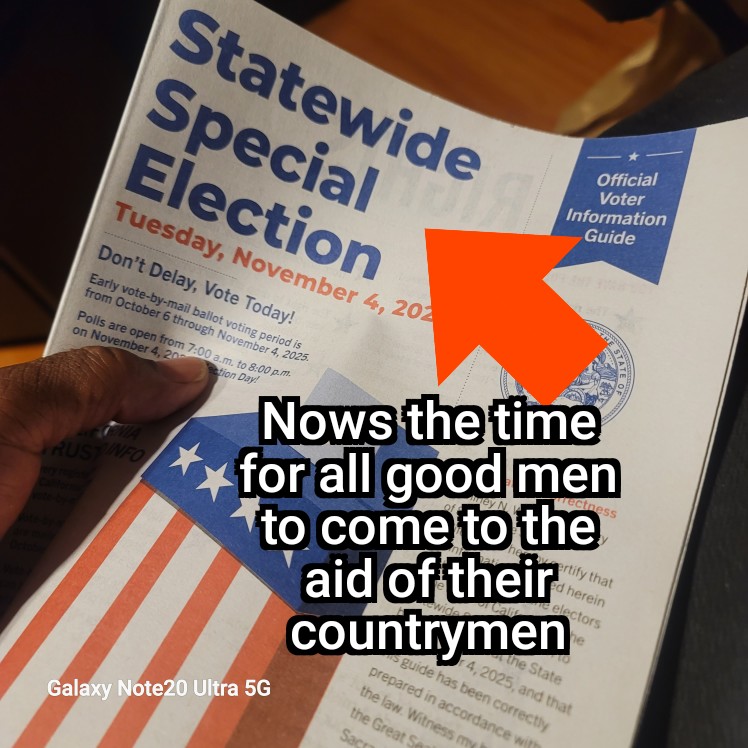
Defend America. VOTE

The state of California leads the charge to defend against Donald Trump’s deceptive attempt to rig upcoming battles for congressional seats. VOTE!

The major special election for California in 2025 is the Statewide Special Election on Tuesday, November 4, 2025.

​All registered voters in California will receive a ballot for this election, which includes a vote on Proposition 50.

​Key Dates for the November 4, 2025, Statewide Special Election:

​October 6, 2025: Vote-by-mail ballots begin to be mailed to all registered voters.

​October 20, 2025: Last day to register to vote.

​November 4, 2025: Election Day.