
By Charles Jackson
 My car is a 2020 Hyundai Santa Fe with the 2.4-liter GDI engine — the standard engine in the lower trims, the SE, SEL, and regular Limited. GDI stands for Gasoline Direct Injection: instead of mixing fuel with air before it enters the cylinder, the injectors spray fuel straight into the cylinder at very high pressure. It’s efficient on paper. In my driveway, it has been something else.
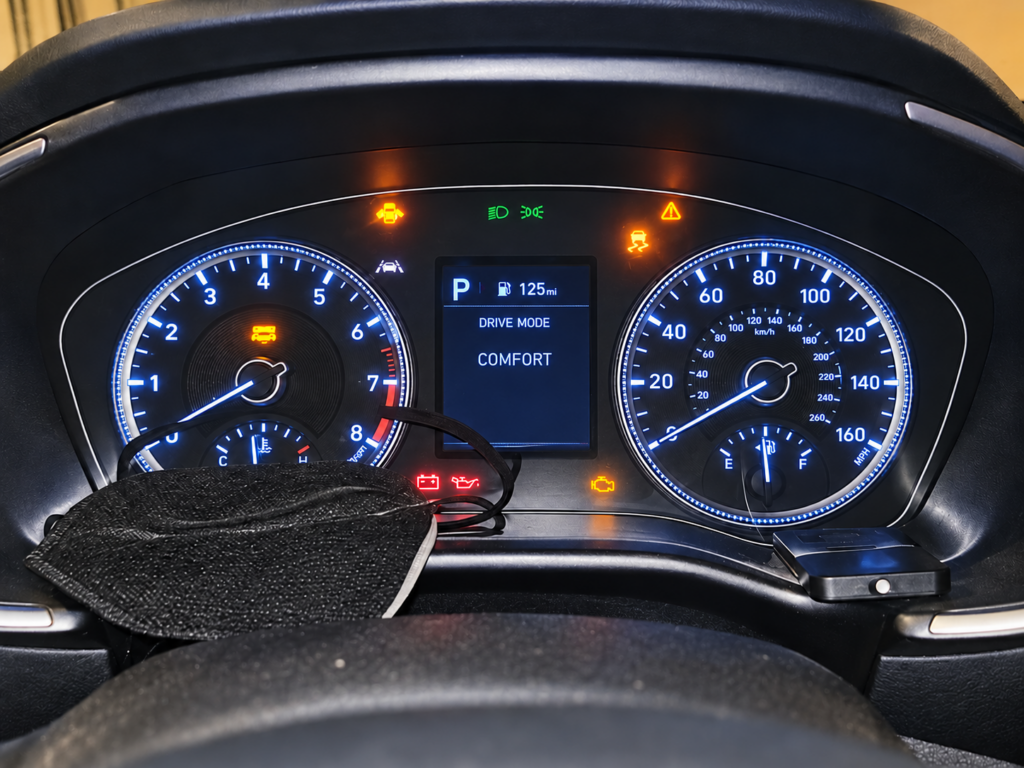 The engine also has Hyundai’s Idle Stop & Go system. Hold the brake at a light and the engine shuts off completely; lift your foot and it restarts. A few months back I started turning that system off by hand every trip — and my check engine light, a regular visitor before, hasn’t come on in about a month. I can’t prove the connection, but here’s a likely piece of it: this engine’s valve timing runs on oil pressure, and my car doesn’t hold onto its oil.
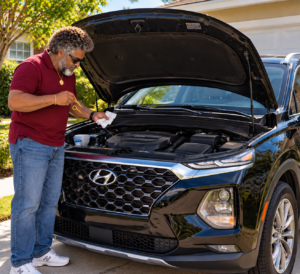 That’s the real problem. I have to add oil every 7 to 10 days, depending on how much I’m driving. At roughly 44 miles a day on my school runs, that’s a top-up every 300 to 450 miles. Hyundai’s own yardstick says burning more than about a quart per 1,000 miles is excessive. By that measure, my engine is burning oil at two to three times the rate Hyundai itself calls too much.
 I’m not an isolated case, either. The 2020 Santa Fe is named in a Hyundai/Kia oil-consumption class action covering 2015–2021 Santa Fes, and the federal safety database is full of owners describing the same story: oil dropping below the low mark every few hundred miles, then stalling, low oil pressure, metal shavings in the pan, and engines failing outright from worn bearings. Oil starvation is what turns my problem into a dead engine, so I keep feeding it oil I shouldn’t have to buy.
Then there’s the other side of this — the waiting game. While my car sat in the shop, I was in rental cars, and it wasn’t accumulating miles because it wasn’t being driven at all. Meanwhile, the legal clocks kept ticking. California’s lemon law deadlines are measured in time, not in how the car was treated, and the recent AB 1755 changes shortened the window further: a claim now has to be filed within a year after the warranty expires, and no later than six years after the car was delivered. Every month spent “waiting on repairs” is a month off the owner’s clock. Whether it’s anybody’s plan or not, delay works in the manufacturer’s favor and against the person still making payments on a car that burns oil.
 So here’s where I stand: still driving it, still topping it off, ISG off, and now keeping a written log — date, odometer, and how much oil went in, every time, receipts saved. “It burns a lot of oil” is an opinion. A quarts-per-mile figure is evidence. If you’re driving one of these engines and feeding it oil between changes, I’d suggest you start the same log. The clock is running either way.