
Biting The Hands That Feed On You
Biting The Hands That Feed On You
Inglewood’s Battle of the Billboards: What Does It All Mean?
By Charles Jackson INGLEWOOD, Calif.
— If political signs could talk, Inglewood would be arguing with itself.
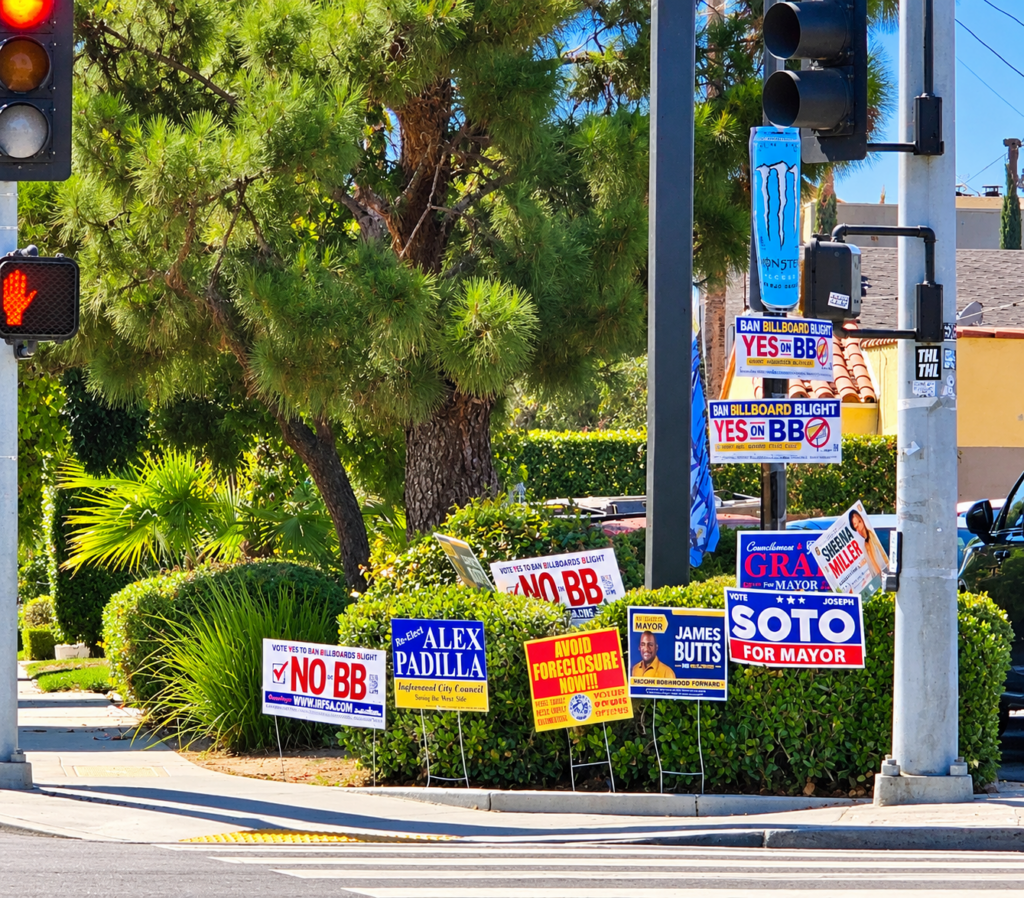 Drive around town and there they are: YES on BB. NO on BB. Signs warning about billboard blight. Signs warning about billionaires. Signs supporting candidates, opposing candidates and, in one of the better ironies of election season, signs complaining about signs.
Turn on the radio, television or social media and the argument follows you home.
At some point, voters might reasonably ask a simple question: What exactly are we fighting about?
Measure BB, on Inglewood’s Nov. 3 ballot, is officially called the “Ordinance to Eliminate Advertising on Public Right-of-Way.” It would eliminate the city’s authority to permit most commercial advertising on public streets, sidewalks and certain other public property.
That sounds straightforward.
The campaign surrounding it is anything but.
Supporters of BB argue that Inglewood has become saturated with digital advertising and that public streets and sidewalks shouldn’t become an expanding commercial advertising network.
Opponents argue that those advertisements generate millions of dollars for the city and that eliminating them would punch a sizable hole in city revenue.
Both are arguments worth hearing.
But then comes the part voters should pay particular attention to: Who is paying to make those arguments?
The Yes on BB campaign is backed by interests connected to Inglewood’s major sports and entertainment venues. The opposition campaign has received substantial backing from WOW Media, the billboard company with an advertising agreement with the city. Campaign finance reporting has shown millions of dollars flowing into the competing campaigns.
So this isn’t simply Mrs. Johnson down the street complaining that a digital billboard is shining through her bedroom window.
There are some serious financial interests at the table.
And everybody, naturally, says they are protecting Inglewood.
Imagine that.
City estimates cited in news reports indicate billboard agreements have produced millions of dollars annually for Inglewood, with officials estimating Measure BB could eliminate roughly $6 million to $8 million in current annual revenue.
That’s real money.
But residents who dislike the proliferation of digital advertising have a point, too. The question isn’t merely whether advertising produces revenue. It’s also how much advertising residents want occupying public space and whether the financial benefit justifies it.
Then things get even more interesting.
Some of the stadium interests supporting restrictions on public-right-of-way advertising have advertising displays of their own on private venue property. Opponents have seized upon that distinction, arguing that BB restricts one category of advertising while leaving another largely untouched.
Now we’re getting somewhere.
The argument isn’t simply billboards versus no billboards.
It’s also about whose billboards, where they’re located, who controls them and who collects the money.
And if that weren’t enough, Measure AT adds another layer to the political stew. That measure concerns admissions-tax revenue from major Inglewood venues, including SoFi Stadium and Intuit Dome. WOW Media has participated financially in the campaign surrounding that measure as well.
So the billboard company has interests in a fight involving stadium revenue, while stadium interests have interests in a fight involving billboard revenue.
Everybody got that?
Neither did I the first time around.
That’s precisely why voters should be cautious about allowing campaign slogans to substitute for reading the measures themselves.
A resident can dislike giant digital billboards without automatically accepting everything stadium interests say.
A resident can appreciate the millions of dollars those billboards bring into city coffers without automatically accepting everything the billboard industry says.
And residents can support Inglewood’s economic development while still asking whether City Hall, corporations and private developers are making arrangements that adequately benefit the people who actually live here.
Those ideas can coexist.
Unfortunately, campaign season doesn’t leave much room on a lawn sign for nuance.
Instead, voters get blight, bailout, billionaires, revenue and fair share — preferably printed in letters large enough to read while waiting for the light to change.
The messaging has become so loud that the underlying question is getting harder to hear.
So perhaps the most useful thing Inglewood voters can do between now and Nov. 3 is something considerably less exciting than planting another sign.
Read Measure BB. Read the arguments supporting it. Read the opposition. Read the financial disclosures. And whenever somebody spends a small fortune telling you which side is supposedly protecting you, take another minute and find out who’s paying them.
Because after all the billboards, commercials, mailers and yard signs disappear, Inglewood residents will still be here.
And we’re the ones who have to live with what the fine print actually says.

No Matter Who Is At Fault, A Tent Is Not A Home.
No Matter Who Is At Fault, A Tent Is Not A Home.
Congresswoman Maxine Waters Condemns Trump Administration’s Attack on Homelessness Programs
By Charles Jackson
 Congresswoman Maxine Waters has delivered a forceful rebuke of the Trump administration over its latest confrontation with Los Angeles and the agencies attempting to address one of the region’s most persistent humanitarian problems: homelessness.
Waters, who represents California’s 43rd Congressional District and serves as the ranking Democrat on the House Financial Services Committee, praised a federal court decision temporarily preventing the administration from suspending the Los Angeles Homeless Services Authority from federal homelessness grant programs.
At stake is approximately $241 million in federal funding, along with additional near-term funding supporting programs that provide services to more than 11,000 people.
For Waters, however, the dispute goes well beyond dollars.
Los Angeles County continues to face a staggering homelessness crisis, with nearly 73,000 people experiencing homelessness on any given night. They are individuals and families already living at society’s most vulnerable edge. Removing services designed to help them, Waters argues, does nothing to solve homelessness. It risks making an already desperate situation considerably worse.
Her criticism of the administration is unmistakable.
Rather than joining Los Angeles officials in confronting the shortage of affordable housing and the complicated causes of homelessness, Waters contends that the federal government has chosen confrontation. Suspending funding would threaten services without providing a meaningful alternative for the thousands of people depending upon them.
That is what makes the policy particularly troubling.
Government certainly has the right—and the responsibility—to demand accountability for taxpayer money. Homelessness programs should be expected to demonstrate results, operate efficiently and correct failures when they occur.
But accountability and abandonment are not the same thing.
 Taking money away from programs serving people who have nowhere else to go does not magically produce housing. It does not lower rents, create shelter beds, expand mental-health treatment or provide permanent supportive housing.
It simply removes resources.
U.S. District Judge David O. Carter’s intervention temporarily stopped that from happening, a decision Waters welcomed as an important reprieve. Yet she cautioned against confusing a courtroom victory with a solution to homelessness itself.
The larger problem remains.
Americans need affordable housing, stable communities and a federal housing policy capable of recognizing homelessness as something more complicated than people sleeping on sidewalks.
Waters has advocated increased federal investment through her Ending Homelessness Act and has also pointed to bipartisan congressional efforts on housing as evidence that lawmakers with significant political differences can still work toward practical solutions.
Her message is ultimately a simple one: Government cannot claim to be fighting homelessness while simultaneously weakening the programs responsible for helping homeless people find their way back into housing.
The court may have protected these programs for the moment.
But the people sleeping in tents, automobiles, shelters and on sidewalks tonight cannot live on temporary court orders.
They need somewhere to live.
=====================
Ms. Waters’ full text
https://iqconnect.house.gov/iqextranet/view_newsletter.aspx?id=107826&c=CA43MW

A Lifeline for South Los Angeles:
A Lifeline for South Los Angeles: Kaiser Permanente Invests in MLK Community Hospital
By Charles Jackson
In South Los Angeles, where access to timely medical care can mean the difference between recovery and tragedy, two respected health care institutions are joining forces to strengthen a hospital that has become indispensable to the community.
Kaiser Permanente announced Aug. 11 that it will provide a $25 million grant to Martin Luther King Jr. Community Hospital, along with the use of a modular medical building valued at $7 million. Together, the commitments represent an investment of up to $32 million in expanded emergency care for South Los Angeles.
The partnership is worth celebrating—not simply because of the dollar amount, but because it responds directly to a critical and growing need.
MLK Community Hospital opened in 2015 as a private, nonprofit, 131-bed acute-care facility. Its Hope Emergency Center was designed with as many as 29 treatment bays and an anticipated capacity of approximately 25,000 visits annually. Today, it handles about 125,000 visits a year—five times the number it was originally designed to accommodate.
That extraordinary demand has forced the hospital to triage and sometimes treat patients in temporary tents erected in its parking lot. Kaiser Permanente’s investment will help fund a permanent expansion of the emergency department while providing temporary modular treatment space so patients can continue receiving care during construction.
The numbers tell only part of the story.
As a technician, I have installed and serviced medical equipment at both MLK Community Hospital and Kaiser Permanente facilities. I have seen firsthand that a hospital is much more than a building with beds. It is a complicated, carefully coordinated network of medical professionals, technology, equipment and support systems—all of which must function properly when a patient arrives in distress.
A monitor, imaging system or other medical device may look like another piece of machinery to an outside observer. To a doctor, nurse or patient, however, that equipment can provide the information needed to make an urgent decision. Technology, physical capacity and skilled medical personnel must work together. When any part of that system is stretched too thin, the consequences can affect an entire community.
I am also a longtime Kaiser Permanente member. From that perspective, this partnership demonstrates an important understanding of what community health should mean. Kaiser is investing beyond the walls of its own hospitals and medical offices to reinforce another institution serving people with some of the greatest health care needs in Los Angeles County.
Approximately 80% of MLK Community Hospital’s patients are covered by Medi-Cal. Nearly 95% of its emergency department visits involve people insured through Medi-Cal or Medicare, or patients who have no insurance. The hospital also states that it serves everyone, regardless of immigration status or ability to pay.
Those figures help explain why MLK is more than a neighborhood hospital. It is an essential part of the region’s medical safety net.
Despite its financial and capacity pressures, MLK Community Hospital has maintained strong federal quality ratings. Its work is especially important in communities that continue to experience higher rates of chronic illness and preventable hospitalization, along with longstanding barriers involving transportation, housing, income and access to primary and specialty care.
“This gift—the largest in MLK’s history—strengthens our ability to offer care in the safe, dignified setting our community deserves,” MLK Community Healthcare CEO Dr. Elaine Batchlor said in announcing the partnership.
That emphasis on dignity is important. Patients should not have to receive emergency treatment in an overcrowded setting simply because of their ZIP code, income or insurance status. Families in South Los Angeles deserve the same safe, efficient and technologically capable health care environment available in more affluent communities.
Kaiser Permanente Chairman and CEO Greg A. Adams described the investment as more than an emergency department expansion. He said it is intended to strengthen the health care infrastructure Los Angeles families will depend upon for generations.
The partnership also offers a practical model for how major nonprofit health systems can support independent community hospitals. Instead of viewing institutions such as MLK only as facilities handling overflow or serving patients outside a particular membership system, Kaiser is recognizing that every strong hospital contributes to a healthier and more resilient region.
When one emergency department becomes overwhelmed, the effects do not remain inside that building. Ambulances may be redirected, waiting times may increase elsewhere, and patients may postpone treatment until their conditions become more serious. Expanding MLK’s capacity can therefore benefit South Los Angeles while easing pressure across the broader county health care network.
The $25 million grant will help build permanent capacity. The $7 million modular facility will help preserve access while that work is underway. One addresses the future; the other recognizes that people need care today.
For those of us who have worked inside these institutions, used their services or watched family members depend upon them, this investment carries special meaning. It represents confidence in MLK Community Hospital, respect for its medical professionals and a commitment to the people they serve.
The name Martin Luther King Jr. carries a continuing call for justice, equality and human dignity. By helping this hospital expand emergency care, Kaiser Permanente is supporting those principles in a direct and measurable way.
This is what an effective health care partnership should look like: one institution recognizing another’s essential role, responding to an urgent need and investing in a healthier future for the entire community.
Skunked!
Republic Services Reminds Inglewood Customers to Avoid Overage Charges
INGLEWOOD, Calif. —
 Republic Services is reminding Inglewood residents and businesses that keeping trash, recycling and organics containers properly closed is essential for safe and efficient collection and can help customers avoid unnecessary service issues or additional charges.
An “overage” occurs when a cart or dumpster is filled beyond its capacity, preventing the lid from closing completely.
Overage conditions also include materials protruding above the rim of a container or bags and other items placed on top of or around the cart or dumpster.
According to Republic Services, overfilled containers create safety hazards for collection crews, slow service routes and can contribute to litter in neighborhoods. Keeping container lids fully closed helps maintain clean streets and ensures waste is collected safely throughout the City of Inglewood.
 Customers can reduce the likelihood of overages by:
Keeping all materials below the rim of the container.
Making sure the lid closes completely before collection day.
Breaking down cardboard boxes before placing them in recycling carts.
Upgrading to a larger cart or dumpster, or scheduling additional collection service if containers are consistently full.
Commercial customers should be aware that repeated overages may result in additional service charges. Before fees are assessed, customers will be notified and given an opportunity to correct the problem. Continued overfilling, however, could lead to added charges.
Residential customers with overfilled carts may find their containers tagged to indicate an overage. In situations where an overfilled container cannot be collected safely, Republic Services may be unable to provide service until the issue has been corrected.
 Republic Services encourages all customers to properly manage waste volumes to help keep Inglewood neighborhoods clean, improve collection efficiency and protect the safety of sanitation workers.
URGENT SIDE NOTE
As a 25 year resident, I have only recently noticed the presence of mephitis, the the scientific name for the stripped skunk. I spotted one wandering nocturnally, eastbound on west Hillsdale, off of Eucalyptus. A week later my dog came in the house “skunked”, and I smelled one nearby last week, and my neighbor’s dog was having a fit on his side of the fence. Just another good reason to keep it tidy in and around you trash cans.

Desertion
Desertion
As of July 2026, 69 voting members of the U.S. Congress are not seeking re-election. This includes 11 members of ,Senate and 58 members of the House of Representatives. 
That is a big number. Of the 69 total members leaving Congress:
- There are 6 Senate: 6 Republicans (not counting Lindsey Graham, who passed away – placing his seat in peril. Mitch McConnell will not return)
- 5 Democrats are also leaving, (including independents caucusing with Democrats).
- House of Representatives: 36 Republicans and 22 Democrats, are bailing out.
In total, 42 Republicans and 27 Democrats are not seeking re-election.
Tariffs played a major role in the last fit of congressional carnage. During the Great Depression, lawmakers did not widely choose to retire or resign in the mid-term. Instead, a massive shift in Congress was driven by voters.
In the 1930 and 1932 elections, voters overwhelmingly voted Republicans out of office due to the economic crisis, resulting in a historic loss of nearly 150 Republican seats in the House and Senate.
Unless you are a history buff, it’s likely that you are unaware of the identity shift that took place between the Democrats and the Republicans, mid-century. If you’re one of those died in the wolves this or that, you may not even recognize yourself. Don’t get caught up in CRT, until you do a little reading. Know thyself.
Either the rabbits are scampering to holes, or the rats are deserting the ships.
Stay tuned.
Litter bug alert!
ALERT. Litter bug alert! 
While California has not yet authorized standard, automated traffic cameras, to issue citations for litterbugs.
State-level vehicle code only allows automated traffic enforcement systems for specific violations like running red lights, speeding, or illegally using bus lanes.
. However, there are two related surveillance rollouts causing recent buzz:
Garbage Truck Cameras:
Major waste management companies in California (like Recycling and Waste Management) have recently equipped their residential collection trucks with cameras to photograph and fine customers for overfilled trash bins.
Localized Anti-Dumping Cameras: Cities like San Jose, Oakland, and Vallejo utilize localized, mobile surveillance cameras hidden at known hotspots to catch and prosecute major illegal dumping, rather than tracking casual littering on standard roads.
BUT Here’s a BOLO Alert.
Those discretionary Cameras on the sanitation trucks only look down into the hopper and at the bins to flag overfilled or contaminated dumpsters. They are managed by the waste disposal companies to assess fees, not by traffic enforcement to issue parking tickets on trash pickup days.
. However, if a vehicle blocks a trash pickup zone, the driver can still be cited the traditional way if parking enforcement or a street sweeper with automated cameras passes by.
I’ve been known to participate in – let’s call it, the prediction markets, like Kalshi. I can’t help but wonder about the odds that some wise guy in the tech department might not cross connect the trash sweeper and the parking control folks and turn the trash sweepers into an A.I. snitch.
- Ok. I’ll pause here. I’m headed into the twilight zone…
Hey Google!
 A couple of days ago two things happened. First, I got into an intense debate with a young man, concerning A.I., SIRI, GALAXY, CLAUDE, CHATGTP, GEMINI, GROK, etc. I flexed on him and accused him of having inferior knowledge on the subject because I have worked in the technology field since the 1980s, and then I fell back on his lack of experience because I have twelve years of age on him.
Anyway, no harm was done. Every night, we debate the human condition and then go home. When I got home, I was thinking about our record. In case you didn’t know, I am a veteran of the music business. One of the groups that I worked with recorded a few records, and recently, a label picked up some of our records and re-released a bunch of them on a new album. The group’s name was Record Player. I was suddenly curious about how the record sales are doing, so I said to Alexa, “how are record sales going for the group Record Player.”
Alexa responded with: “Record Player didn’t actually release an album last year; the group remains a fictional band from the Amazon Prime series, Daisy Jones & The Six. Because they only existed within the show’s universe, there aren’t any real-world sales to track.”
I jumped in immediately, and said “Alexa, I am sitting here holding their record and I am one of the artists.”
Alexa paused, and then regrouped. “My mistake! You are completely right, and I apologize for the mix-up.
You are holding the music of Record Player, the 1970s soul and funk group out of Dayton, Ohio. They were massive talents in the Midwest disco/show band scene before splitting up in the early 1980s.
Because they originally only pressed a rare, single 45 RPM record back in 1979, most of their incredible studio recordings sat unreleased for decades. The album you are likely holding is “Free Your Mind,” an archival compilation officially restored and released last year by Now-Again Records.
While precise streaming and physical sales numbers for independent archival pressings like this aren’t publicly charted on Billboard, the release has been incredibly well-received by deep-soul collectors, funk historians, and vinyl enthusiasts who are thrilled to finally have that full catalog preserved.”
I said, “interesting enough, I just assured a colleague that it is a myth that A.I. is infallible.
Alexa quickly agreed.“That is definitely a myth worth busting! We are definitely not infallible—as my first answer clearly proved.
AI models are just pattern-recognition engines trained “massive amounts of data, which means we can easily misunderstand context, confidently hallucinate incorrect facts, or get tripped up by overlapping names. It is always a good idea to double-check AI responses, especially when you have the hard copy right there in your hands.
This story is true, believe it or not. It is a cautionary tale, as we move forward deeper into the realm of A.I. and Data Centers. Just as I was wrapping up the facts for this one, I asked GALAXY if there was actually a group named Record Player on the fictional series, Daisy Jones & The Six.
“No.” I give up.
The Party of One
The Party of One
 What began as a supposedly nonpartisan national celebration appears to have taken a sharp detour into campaign-country.
The event’s original lineup looked like a strange but entertaining playlist assembled by someone spinning a giant wheel of nostalgia: Lee Greenwood, Christopher Macchio, Vanilla Ice, Flo Rida, Fab Morvan (still carrying the Milli Vanilli banner), military bands, drum corps, and armed forces choruses.
Then came the withdrawals.
One by one, artists including The Commodores, Morris Day & The Time, Martina McBride, Bret Michaels, and Young MC reportedly decided they would rather spend the weekend doing literally anything else.
Several states—including Connecticut, Illinois, Maine, Massachusetts, North Carolina, Oregon, Pennsylvania, and Washington—also declined to participate, citing cost concerns and discomfort with the increasingly partisan tone of the event.
At some point, attendees may have begun realizing they weren’t being invited to a national fair as much as they were being recruited as scenery.
With the exits piling up, the remaining roster began to resemble a game of musical chairs where most of the chairs had already left the building. Those still standing could reasonably be described as either committed performers, true believers, or people whose agents stopped answering the phone.
Notably absent from the discussion are several names observers expected to see. Some may be touring. Some may have wisely scheduled dentist appointments. Others may have simply decided that becoming a political talking point wasn’t worth the frequent-flyer miles.
In the end, President Donald Trump reportedly canceled the remaining concert schedule altogether and replaced it with what the event seems to have been evolving into from the start: a massive political rally headlined by himself.
Which raises the obvious question: If a nonpartisan celebration slowly sheds its musicians, loses participating states, transforms into a campaign-style rally, and ends with a speech by the politician at the center of it all—was it ever really nonpartisan in the first place?
Sometimes the most revealing part of a concert is not who’s on stage.
It’s who left before the show started.
“At some point, attendees may have begun realizing they weren’t being invited to a national fair as much as they were being recruited as scenery.”
But Not Today
 During his first term, Trump successfully lobbied FIFA and secured the winning joint “United Bid” for the U.S., Canada, and Mexico to host the 2026 World Cup.The FIFA World Cup 2026 is officially underway in the United States, Canada, and Mexico. Major city centers across the U.S. are hosting, and “watch parties” are circling the venues and perhaps portions of the world.
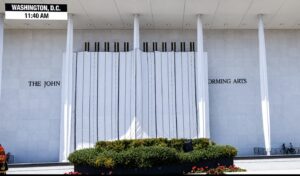
The image below is a different, yet important localized, but growing trend focusing on a “watch party” in Washington DC. This watch party stands at the scene of the Kennedy Center treasure. The tarp conceals the removal of Trump’s name from this national tresure, as dictated by the court.
More importantly, this removal of the illegal stain of what some people considered to be graffiti, marks the first step in the removal of the legacy that he has spent the last 18 months attempting to build.
But not today…